
Retirement planning is one of the most important financial goals in life of a person. Most of us have heard about Employee Provident Fund (EPF) and (Public Provident Fund) PPF for building retirement corpus but do you know how can you leverage Voluntary Provident Fund (VPF) to add zing to your corpus?
What is Voluntary Provident Fund?
In EPF, an employee has to contribute 12% of his basic pay towards his provident fund account. An equal amount is contributed by his employer. Apart from contributing the normal 12% of his basic pay, employee may choose to put in more than this, up to 100% of his basic and D.A., voluntarily. The contribution is known as Voluntary Provident Fund and will earn the same rate as normal EPF contribution. But remember, your employer will not be required to ‘volunteer’ to contribute more than the 12% mandate.
VPF Vs EPF?
Both are almost the same! Once the contribution is made through VPF, it is treated exactly like contribution through EPF. So you can say VPF is extension of EPF as VPF is deposited to your existing PF account. Therefore, all rules that apply to interest rate/loan/transfer/withdrawal from EPF apply to VPF as well.
How to invest in Voluntary Provident Fund?
Investing in Voluntary Provident Fund is a simple process and just requires you to inform your employer to deduct a certain proportion of your pay (subject to the limit mentioned above) additionally, every month. You can contact the Finance/Payroll/HR department of the company. Generally there is a pre-specified form with the concerned department which you need to fill, sign and submit to the department. It mainly asks for how much of Basic and DA you want to contribute to your VPF account. The choice would vary from 0% to 88% of basic + DA (88% because 12% is already invested in EPF).
Also most of the companies entertain new VPF or VPF changes only once a year i.e. at the start of respective financial year (April). So, probably March is the right month to start inquiring about opening VPF with your HR or payroll department, so that you can start contributing from April.
How is Voluntary Provident Fund Taxed?
Voluntary Provident Fund is taxed similar to Employee Provident Fund. Its follows EEE (Exempt, Exempt, Exempt) taxation. This means that the investment in VPF is out of the tax net throughout its life cycle viz. investment, earning and withdrawal. But In case one makes a premature withdrawal, before five years of continuous service, the amount becomes taxable.
VPF investment is also part of 80C instruments where you can invest to save taxes up to Rs. 1.5 lakh.
VPF or PPF?
Public Provident Fund is still the most popular vehicle for tax saving and retirement planning. But, you have quite a few reasons why you should prefer Voluntary Provident Fund over Public Provident Fund or at least in addition to PPF.
Whether you want the tax benefit or not, you cannot invest over Rs 1.5 lakh in PPF. In case of VPF, you can invest well over the Section 80C ceiling.
You may not be a disciplined investor in PPF. Also, you will have to take the trouble to deposit the amount in your bank or post office. In case of VPF, your employer will do this for you as the amount is directly deducted from salary.
Interest rates on PPF, in recent years, have been lower than rates notified in EPF. Also, private-trust run EPFs may even manage a higher rate.
The clause to avail a loan based on your PPF is more restrictive compared to your EPF.
If you want to call it a day at your office, you can withdraw the entire sum (not taxable if you have worked for over five years). PPF is locked in for 15 years and allows only partial withdrawal.
Your contribution grows in proportion to your salary.
Also Read: 15 Investments to Save Tax u/s 80C – Which is the Best?
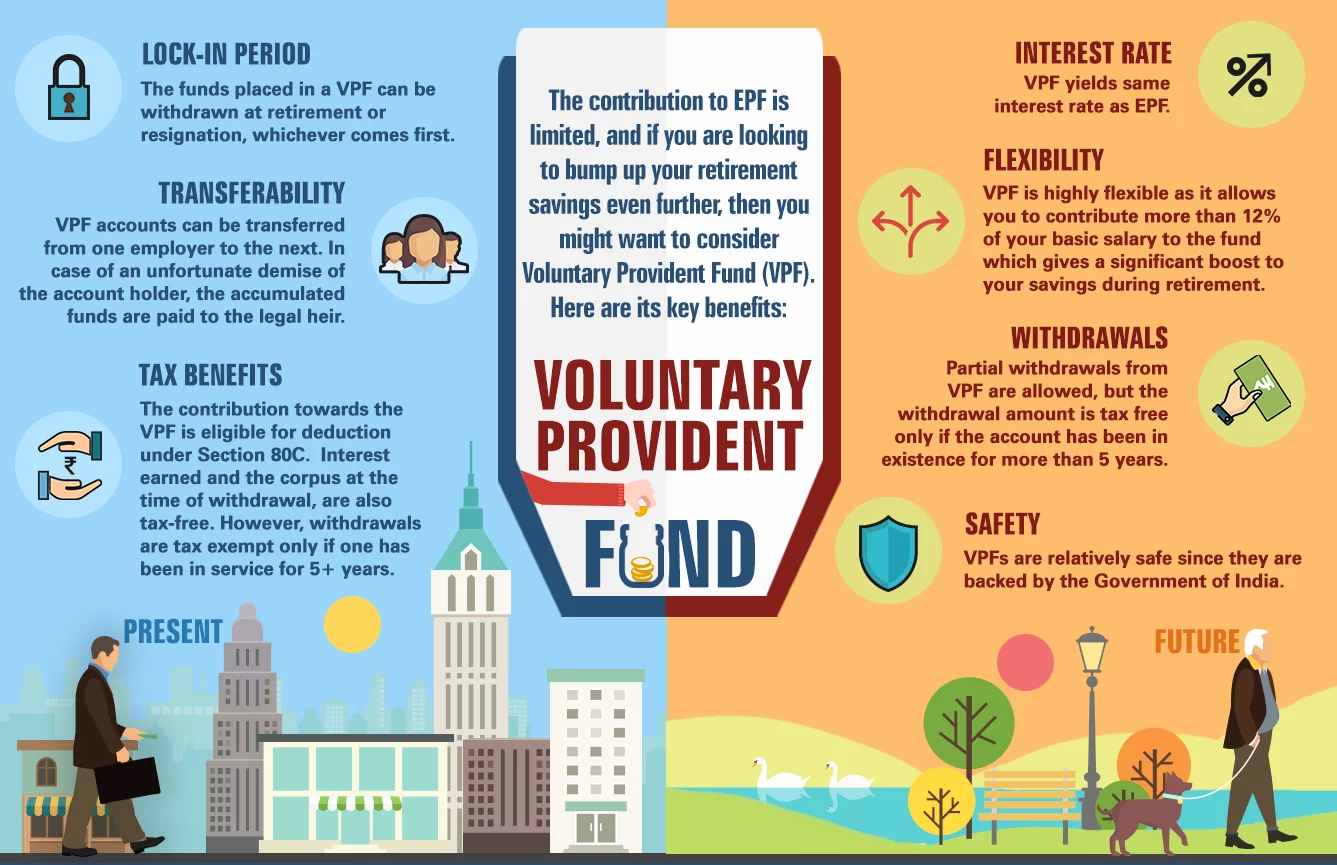
Limitations of VPF:
Applies only to Salaried Class: The Provident fund and Voluntary Provident Fund applies only to salaried class. PF is not compulsory if you are working in a company with employee strength less than 20. Similarly, if you are a businessman or a self employed, you do not have a PF.
Interest Rates are Liable to change: The Government declares the interest rate for both PF (VPF) and PPF each financial year. Right now VPF offers better interest rate than PPF. These rates can change in the future and can be the opposite. But as a sigh of relief, PF’s interest rate has always been higher than PPF in the past.
Cannot alter your contribution midyear: The VPF once declared is deducted from the salary by the employer itself. So you cannot escape paying towards VPF once you commit as most employers do not allow you to alter your contribution mid-year. You may reduce or increase it annually.
Also Read: PPF – A Must Have Investment
Recommendation:
Given the benefits of Voluntary Provident Fund for salaried, it is a very good option to save for retirement and at the same time get tax free income and save tax especially for conservative investors.
Sir,
You have given a detailed post on VPF but it would have been great if it covered the eligibility for pension through EPF ?
What is the minimum age of retirement to qualify for availing Pension through EPF ?
Can this Voluntary Contribution be paused at a later stage, if financial condition is such to get more take home Salary.
Nice Info, Amit!
VPF is one of the most preferred savings schemes for salaried people because interest rates are high, at present 8.65%. Like Provident Fund, all withdrawals from the VPF after 5 years of continuous contributions are completely tax free. If the employee desires to make a withdrawal within the first 5 years of enrolment in the scheme, the interest earned over the deposits will be subject to tax.
If you want to know more, visit this channel https://www.youtube.com/channel/UCthN3CTgZY0WIE9A5u1Qcew
in VPF- is employer deduction is 12% and employee no limit?
For VPF employer is under no obligation to contribute while employee can contribute up to 100% of his (basic salary + dearness allowance)
Can I withdraw VPF once I quit the company. I wanted this information as I m making VPF from past 6 months and I am worried if I am not getting VPF.
Please let me know how the VPF withdrawal process work and what is the time frame to get the VPF money once you apply. Please help me with the detailed information.
VPF withdrawal process is same as EPF. So you should not worry about getting your VPF. If you change your job you can transfer your EPF along with VPF to your new employer.
i am applied for vpf and i also got uan and i am not getting information on how interest added..
example: if i invest 10000rs every month in vpf.. what will be the interest added first year …
then for second year = first year total + second year total + interest is it like that
kindly add one excel formula sheet…
In case of EPF/VPF the interest is added to your corpus every month. Assuming 8% interest if you deposit Rs 1000 for first month, at the end of month the interest would be Rs 6.66. This would be added to the Rs 1,000. In second month when you contribute Rs 1,000 again the interest would be calculated on Rs 1000 + 1006.66 = 2006.66 and so on! In simple terms it works like recurring deposit.
How to apply for VPF account?
Usually at the start of financial year (i.e. in April) employers ask for an option to subscribe to VPF. In case you have not been asked contact your HR or Salary processing team. They can help you. keep in mind you cannot change this option for entire financial year.